
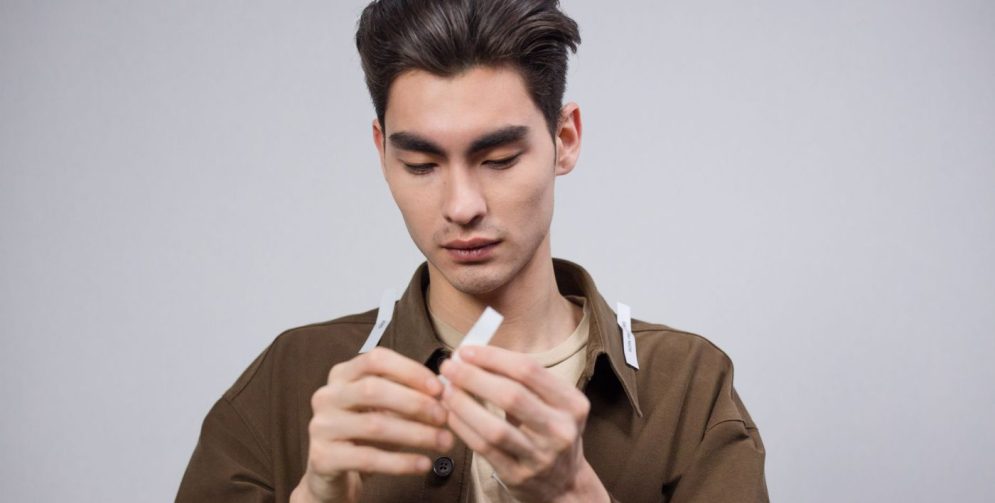
What defines a Korean style haircut for men
A Korean style haircut is built on softness and movement, not sharp lines. The silhouette reads as rounded and intentional, with weight sitting higher on the crown and the fringe kept long enough to sweep across the forehead. Sides are tapered but rarely taken down to skin, so the transition from temple to top stays gradual. The nape is cleaned up without a hard block or a faded edge.
Where a classic Western cut often relies on a crisp side part and tight graduation, a Korean cut leans into heavy texturizing. The barber uses thinning shears or point cutting to remove bulk inside the shape, which lets the hair fall in separated pieces rather than a solid mass. Layering is soft and internal, so the outer perimeter keeps a full look even when the inside is thinned out.
These styles share a common foundation:
- Longer fringe that reaches the eyebrows or sits just above them, styled forward or parted off-center.
- Rounded top silhouette created by stacking weight through the crown and keeping the profile curved.
- Sides and back that are tapered with scissors or a longer guard, avoiding a skin fade.
- Internal texturizing that removes density without making the ends look wispy or broken.
- Natural flow that works with straight or slightly wavy hair, letting the cut hold its shape as it grows out.
Which face shapes suit a Korean style haircut

Oval faces can pull off almost every Korean style cut. The balanced proportions let you experiment with a heavy straight fringe, a curtain split, or a pushed-up volume style without worrying about throwing off your natural symmetry.
Round faces benefit from height and side volume. Ask your barber to keep the fringe lifted or swept sideways rather than cut blunt and straight across the forehead. Tighter sides with layered volume on top elongate the face, creating the V-line silhouette that Korean styling aims for.
Square and long faces both need the fringe to do most of the work, but in opposite ways. A square jaw softens under a textured forward fringe that breaks up the horizontal line. A longer face shortens visually when you wear a full, straight fringe sitting right at the brow line. Avoid pushing the hair straight up if your face reads long, as it pulls the proportions further.
Heart-shaped faces, wider at the temples and narrow at the chin, need side fullness around the jaw. A two-block cut with more weight left through the mid-section and a side-swept fringe balances the narrow lower half. Keep the top layered but not overly tall.
- Oval: any fringe style works, from blunt to parted.
- Round: lifted fringe and layered top height.
- Square: textured forward fringe to break the jawline.
- Long: full straight fringe sitting at the brow.
- Heart: side volume and a side-swept fringe.
How to ask your barber for a Korean style haircut
Walking in and asking for a "Korean haircut" will get you a blank stare because the term covers dozens of different shapes. Your barber needs to hear the specific structural elements that make the cut work. Start by naming the overall silhouette you want, then describe each section separately: the fringe, the crown, and the sides.
Show a photo on your phone. Choose a picture that matches your hair type and face shape, and hold it up before you sit in the chair. Add a few technical terms to confirm you know what you want and to help the barber adjust the cut to your head shape.
- Say "soft layered cut with a disconnected heavy fringe" for the classic comma or curtain style. This tells the barber that the top stays long and textured while the fringe falls forward as a distinct block.
- Ask to "keep the weight line low around the occipital bone" if you want the bowl-like silhouette common in two-block cuts. The weight sits at the back of the head instead of tapering out.
- Request "texturize the top with thinning shears but keep the sides blunt and heavy" for the down perm look. Blunt sides create the solid perimeter that contrasts with the messy, piece-y top.
- Specify "point cutting on the fringe ends, not a straight-across line" to avoid a stiff, helmet-like front edge. Point cutting softens the line so the fringe moves and can be parted or swept sideways.
- For the back and sides say "square-off the nape, no taper" when the reference photo shows a clean, blocky finish. A tapered nape changes the silhouette and makes the cut read more classic than Korean.
- Clarify "leave enough length in the fringe to reach the eyebrows when dry" so the barber accounts for your hair's spring-back. Cutting the fringe to the brow line while wet often leaves it too short once styled.
If the barber asks how you part your hair, answer based on the variation you want. A middle part suits curtain bangs and elongated face shapes, while a side part or no part works for a forward-swept fringe. Saying "I style it forward with a slight wave, no defined parting" points the barber toward the right layering pattern on top.
Popular Korean haircut variations for men

Barbers who specialize in Korean men's cuts typically name a handful of variations that return most often. Each one works with a different hair length and texture, so you can choose based on what your hair does naturally.
The two-block cut keeps the sides and back cropped short while the top stays longer and heavier, creating a clear separation between the upper and lower sections. It suits straight or slightly wavy hair with medium to thick density, and the weight on top helps balance a round or square face shape. Comma hair takes the two-block idea and adds a curved fringe that sweeps down and to one side like a comma mark. The fringe needs enough length to reach the eyebrows, and it works best on fine to medium hair that holds a soft bend. A diamond or heart-shaped face benefits most from the comma shape because it narrows the forehead without hiding it completely.
See-through bangs are a lighter alternative where the fringe is cut with thinning shears or point-cutting so the forehead remains partially visible. Straight hair with fine to medium texture holds this style best, and the soft edge flatters oval and heart-shaped faces by breaking up the forehead line without adding bulk. The soft bowl cut is the last variation. Unlike the blunt, heavy bowl cut, this version has textured ends and a gentle taper at the sides. It requires straight, dense hair and a balanced face shape, typically oval or oblong, where the rounded silhouette does not exaggerate the jawline.
- Two-block cut with short sides and a longer top, for straight or wavy medium-density hair on round and square faces
- Comma hair with a curved side-swept fringe reaching the eyebrows, for fine to medium hair on diamond and heart-shaped faces
- See-through bangs with thinned-out fringe that shows the forehead, for straight fine-to-medium hair on oval and heart-shaped faces
- Soft bowl cut with textured ends and tapered sides, for straight dense hair on oval and oblong faces
How to style a Korean haircut at home

The daily routine starts with towel-dried hair. You want the hair damp, not soaking wet, so water does not dilute your product. Work a small amount of lightweight mousse or a sea salt spray through the roots to the ends. These products add the texture and grip you need before any heat touches your hair.
Attach a concentrator nozzle to your blow dryer and use a medium heat setting. Take a round brush and lift the hair at the roots, directing the airflow upward and back. This builds the soft volume that sits at the crown and keeps the sides from falling flat. For the signature parted fringe, angle the brush diagonally across your forehead while drying, pushing the front section to one side.
Once the hair is fully dry and the shape is set, warm a pea-sized amount of matte clay or styling wax between your palms. Apply it to the dry hair using your fingers, starting at the back and moving forward. Pinch and twist small sections at the front to define the separation in the fringe and lock in the texture for the rest of the day.
- Towel-dry hair until damp, then apply a sea salt spray or lightweight mousse from roots to ends.
- Blow-dry with a round brush and a concentrator nozzle, lifting the roots to create volume at the crown.
- Angle the brush diagonally across the forehead to shape the parted fringe while drying.
- Warm a matte clay or wax between your palms and work it through dry hair, starting at the back.
- Pinch and twist the front sections to sharpen the fringe separation and add definition.
How often you need a trim to maintain the shape
A Korean style haircut relies on a heavy, disconnected shape with soft internal layers. That shape grows out noticeably within three to four weeks. The weight line that sits around the occipital bone drops, the fringe loses its structured curve, and the sides start to push outward instead of lying flat. You will see the silhouette shift from a rounded, compact form into something bulkier and less intentional.
Most barbers recommend a maintenance trim every three to four weeks to keep the perimeter clean and the weight line in the right spot. If your hair grows fast or you wear a shorter variation like a two-block cut, you may need to book an appointment closer to the three-week mark. At a maintenance appointment, ask the barber to take down the sides and the back while leaving the top length mostly untouched. Specify that you want to preserve the heavy shape and just clean up the outline. This keeps the haircut looking fresh without losing the length you have built on top.
FAQ
Can I get a Korean style haircut if I have thick, straight Asian hair?
Yes, thick straight hair is actually the ideal starting point for most Korean cuts because it holds the heavy, blunt shape well. Your barber will likely use thinning shears to remove bulk and create the soft, piecey texture that defines the style.
Does a Korean haircut work with curly or wavy hair?
It can, but the result looks different from the straight-haired reference photos. You will need a longer top to account for curl shrinkage, and the barber should cut the hair dry to see the natural fall. Styling will require a curl cream instead of wax to keep the texture soft.
What is the difference between a two-block cut and an undercut?
A two-block cut keeps the sides blunt and full, with a clear but not shaved separation from the longer top. An undercut typically has a tighter fade or shaved section that creates a harsher contrast. The two-block reads as softer and more rounded, which is the core of the Korean aesthetic.
How do I keep the fringe from falling into my eyes all day?
Blow-dry the fringe forward and then use a round brush to sweep it to one side while applying medium heat. A small amount of matte wax worked into the ends will hold the separation without making the hair look stiff or wet.
