
What is the best haircut for a man with thick hair?
No single cut suits every man. The right choice depends on your face shape, how your hair grows and the effort you want to put into styling. But all good cuts for thick hair share one goal: they remove bulk in the right places so the hair sits properly instead of sticking out.
A barber who knows thick hair reaches for thinning shears and texturising techniques before a clipper. The result is a shape that looks deliberate, not just heavy and shapeless. These four styles consistently work for men with dense hair.
- Textured crop. Short on the sides with a heavily textured top that breaks up the density. The fringe stays forward, so weight does not pull the front down.
- Low fade with a layered top. The fade keeps the sides tight while the top gets point cutting to remove weight. You get a clean silhouette without the helmet look.
- Messy quiff. Length on top gets thinned out with a razor or texturising scissors. The messier the finish, the better it hides how much hair you actually have.
- Classic scissor cut. No clippers at all. A barber shapes the hair entirely with scissors, cutting into the ends to create natural movement. Works especially well on wavy thick hair.
What you avoid matters as much as what you choose. A blunt one-length cut turns thick hair into a solid block. An undercut without enough texture on top looks top-heavy. Ask your barber to show you where they are removing weight before they start.
How do I ask my barber for a cut that handles thick hair?
Walk in and say "I need weight taken out so it does not puff up on the sides." That one sentence tells your barber you want a shape that holds, not a bulk removal that leaves you with a hedgehog look. Follow it with "keep the length on top but texture it so I can style it flat." This moves the conversation on from a generic "short back and sides" and puts the focus on controlling density.
If your hair grows outward before it grows down, ask for a disconnected undercut. The phrase is "take the sides high and tight with no blend into the top." This removes the heavy shelf that forms above the ears and lets the top fall naturally. For men whose hair stands straight up, request thinning shears on the crown only: "use the thinning scissors just on top to knock down the bulk, not the length."
Three more requests that work on thick hair:
- Ask for point cutting on the ends of the top section. This softens the blunt line that makes thick hair look blocky.
- Request a low fade on the back instead of a taper. A fade removes more weight from the occipital bone where thick hair bunches up.
- Say "leave the parietal ridge heavy but chip into it with scissors." This keeps the square shape without the mushroom effect.
- Ask your barber to show you where your hair changes direction. Thick hair often has a strong growth pattern, and cutting against it makes styling harder.
What clipper guards and scissor techniques work on thick hair?
A skilled barber uses specific cutting methods to remove bulk without creating a helmet-like shape. The goal is controlled texture, not just shorter length. Standard blunt scissors can leave hard lines on dense hair, so techniques that soften the ends are vital.
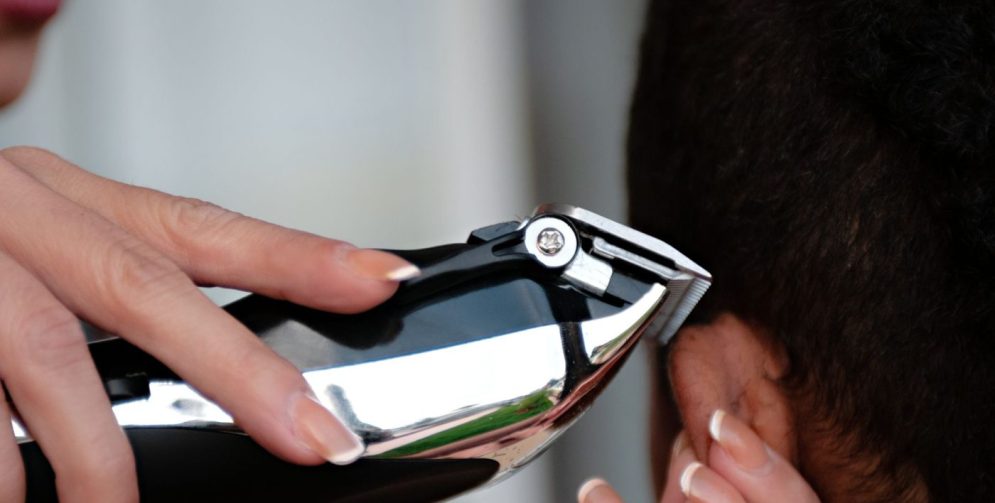
Clipper-over-comb is the foundation for fading thick sides. The barber lifts the hair with a comb and runs the clipper over it, which cuts at an angle above the skin. This stops the hair from sticking straight out as it grows. For the top, scissor work takes over.
These are the core techniques a good barber will use on your hair:
- Point cutting: The barber holds the scissors vertically and snips into the ends. This removes weight and creates soft, separated texture instead of a solid blunt line.
- Slide cutting: The scissors glide down the hair shaft while partly open. This thins the hair in a gradual, natural way and adds movement without visible steps.
- Clipper-over-comb blending: The barber uses a comb to control the hair angle and runs the clipper across it. This tapers the sides smoothly and prevents the hair from bulging.
- Razor finishing: A straight razor or a razor comb feathers the very ends. This breaks up dense edges and helps the cut grow out softer over the following weeks.
How do I style thick hair at home without it puffing up?
Start with damp, not soaking wet, hair. Towel dry until no water drips, then apply a product that adds weight and control. A clay or a matte paste works better than a gel or a water-based pomade because those can make thick hair look wet and heavy without taming the volume. Work a fingertip sized amount between your palms and distribute it from roots to ends.
A hairdryer with a concentrator nozzle is your main tool for directing thick hair. Point the airflow down the hair shaft from root to tip to smooth the cuticle and lock the shape in place. Finish with a cold shot button if your hairdryer has one. That sets the style and reduces the puffiness that warm air can leave behind.
- Apply mousse to towel dried hair before blow drying for extra hold and heat protection.
- Use a vented brush to lift roots while drying if you want volume that stays controlled.
- Keep a matte clay in your bag for midday touch ups if humidity makes hair expand.
- Wash thick hair two to three times a week to keep natural oils that weigh it down.
How often should I get a haircut if I have thick hair?
Most men with thick hair need a cut every 3 to 4 weeks to keep the shape clean. After that point the weight of the hair starts to pull the style apart. The sides begin to bulge outward and the top loses the texture your barber cut into it, making the whole head look round and heavy instead of sharp.
You can spot the signs before the mirror tells you outright. Run your hand up the back and sides. If the hair feels solid and you can pinch more than a few millimetres between your fingers, the shape has already started to collapse. On top, watch for the moment your usual styling product stops holding the separation and the hair falls into one solid block. That is your cue to book the next appointment, even if the calendar says it has only been two and a half weeks.
Men who wear a skin fade or a high-contrast undercut often sit in the chair every 2 to 3 weeks, because a couple of millimetres of regrowth on thick hair is far more obvious than on fine hair. If your style is longer and more blended, you can stretch the interval closer to 4 or 5 weeks. The rule is simple: the shorter and sharper the perimeter, the more unforgiving the regrowth.
FAQ
Can I have long hair if my hair is thick?
Yes, long styles work well with thick hair because the weight pulls the hair down and reduces poofiness. Ask your barber to add long layers and remove internal bulk with thinning shears so the hair moves naturally and does not form a triangle shape.
Does a fade work for thick hair?
A fade is one of the most practical choices for thick hair. By keeping the sides short and tapered, you remove the bulk that causes the head to look wide. The contrast with a longer, textured top gives a clean, modern shape that is easy to maintain.
What products stop thick hair from looking dry or frizzy?
Matte clays and fibre pastes give a strong hold without shine, which helps control thick hair. If frizz is a problem, apply a small amount of leave-in conditioner or argan oil to damp hair before styling. Avoid high-shine pomades, as they can make thick hair look heavy and greasy.
