
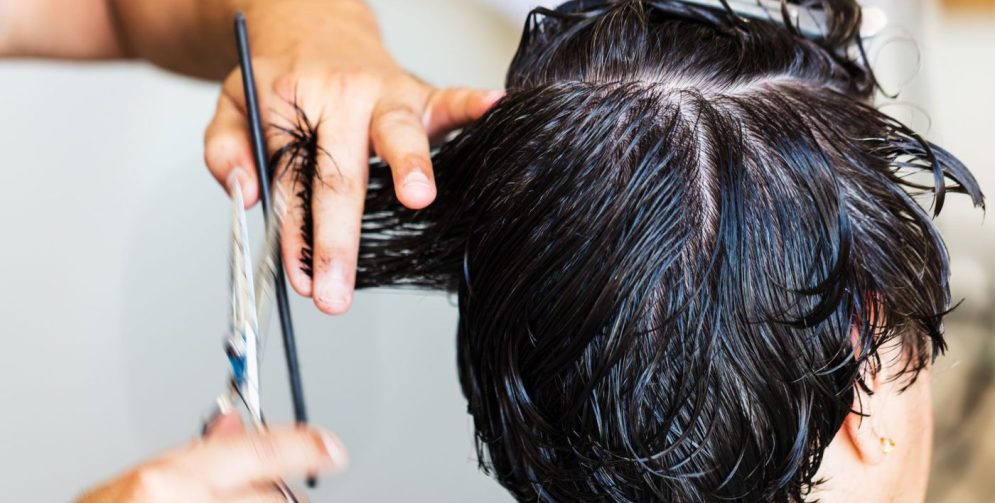
What makes wavy hair different from curly or straight hair
Wavy hair sits between straight and curly on the Andre Walker scale, classified as type 2. The follicle is slightly oval rather than round, so the strand grows with a loose S-shape pattern instead of falling flat or forming tight coils.
Straight hair reflects light evenly along a smooth shaft, which makes it look shiny. Curly hair bends sharply and scatters light, so it appears more matte. Wavy hair does both: the flatter sections catch some shine while the bends add texture. That mixed surface means a cut that works for straight hair can look shapeless on waves, and a cut designed for tight curls can sit awkwardly on looser S-patterns.
The wave pattern also affects how hair behaves day to day. Straight hair tends to lie where you put it. Curly hair has strong natural lift and shrinks as it dries. Wavy hair falls somewhere in between, lifting at the root and bending through the mid-lengths, but without the spring-back of curls. Humidity can flatten the wave or turn it frizzy, so the right cut works with that unpredictability instead of fighting it.
Which haircuts suit wavy hair best
A textured crop gives wavy hair structure without fighting its natural movement. The top stays short enough to avoid bulk, while the choppy layers let each wave sit with a bit of separation. Ask your barber to point-cut the top and keep the fringe piecey rather than blunt.
A classic taper works because the gradual shortening on the sides removes weight that would otherwise push the wave outward. The top can stay two to three inches long, which is enough length for the wave to show but not so much that it flops. Tell your barber you want the sides tapered from a grade two down to skin, with the top left textured.
The medium flow uses length and layering to let waves fall back from the face. The key is removing weight from the crown so the hair does not stack up. A modern quiff suits wavy hair when the front is left heavier than the back. This gives the wave a forward sweep that holds shape all day. A messy fringe pairs well with a loose wave. The irregular lengths make the style look deliberate even when it dries naturally.
- Textured crop: point-cut layers on top, short textured fringe, low or mid fade on sides.
- Classic taper: two to three inches on top, sides tapered from a grade two to skin, light texture throughout.
- Medium flow: layered throughout, length reaching the ears, weight removed from the crown.
- Modern quiff: longer fringe swept up and forward, shorter back, faded or tapered sides.
- Messy fringe: uneven fringe length, razor-cut for softness, low taper or natural neckline.
- Layered mid-length: hair below the ears, long layers cut at an angle, minimal thinning at the ends.
Layered mid-length cuts let waves form full S-shapes without the triangle effect that happens when thick hair is left one length. The barber cuts long layers at an angle so the hair tapers toward the ends, removing bulk from the bottom half.
How short can you cut wavy hair without losing the wave
You typically see the S-pattern in wavy hair once the top reaches about 5 cm. Cut shorter than that, and the hair lacks the length to complete its natural bend. It sits straighter or sticks up unevenly. The sides can go much shorter without issue because the wave on top carries the style.
A number 3 or 4 guard on top loses most of the visible wave. The hair will look thicker and may form a subtle bend rather than a defined S-shape. A classic crew cut or a short crop still hints at texture. Ask your barber to leave the fringe slightly longer and use thinning shears to soften the weight line. A textured French crop with a short fringe keeps a suggestion of movement without requiring length.
For a short style that still looks clearly wavy, ask for 5 to 7 cm on top with tapered or faded sides. The contrast between the short sides and the longer top makes the wave stand out more than a uniform length all over.
How to ask your barber for a wavy haircut
Tell your barber three things: your wave pattern, how you style it every morning, and where you want the weight taken out. A barber who knows those three things can shape the cut to suit your hair, not fight it.
Describe the top length in inches or by how far you can pull it forward. Say "leave it long enough that the wave still bends twice" if you want movement, or "take it down to where the wave just starts to show" for a shorter look. For the sides, name a guard number you have liked before, or ask to see a 3 against a 4 before they start.
Describe your daily routine in one sentence. "I towel-dry it and go" tells the barber something very different from "I blow-dry it with a round brush every day." That single sentence tells them where to leave weight and how to blend the crown.
- Name your wave type. Say "my wave starts about an inch from the root and bends twice before it hits my eyebrow" instead of just "it is wavy."
- Show where the bulk bothers you. Point to the heavy spots, usually above the ears and at the back crown, and say "can you take the weight out here so it sits flatter."
- Ask for a cut that works with your morning routine. If you air-dry, ask them to cut it dry so they see the true shape. If you blow-dry, have them cut it after you style it the way you normally would.
- Request texture scissors on the top only if your wave tends to clump. Say "thin out the ends, not the roots, so the wave still holds together."
- Bring a photo of a haircut on hair that has a similar wave to yours. A picture of a straight-haired model tells the barber nothing useful.
- Before you leave the chair, ask "what guard did you use on the sides and how long is the top" so you can ask for the exact same thing next time.
Which face shapes pair well with wavy styles
Wavy hair works across all face shapes because the natural texture adds movement that you can direct to balance proportions. The key is controlling where the volume sits. For a square face, longer waves on top and at the sides soften a strong jawline without hiding it. A round face benefits from height at the crown, which stretches the silhouette visually and stops the head looking wider than it is.
An oval face gives you the most freedom. A side part with controlled wave keeps the natural balance intact and avoids adding unnecessary width. For oblong and diamond faces the rule flips: you want width, not height.
- Square face: keep waves longer through the top and fringe to break up angular lines at the jaw and temple.
- Round face: build volume at the crown with a textured crop or quiff; keep the sides short to avoid adding width.
- Oval face: a classic side part with medium-length waves maintains the face’s natural proportion without over-accentuating any feature.
- Oblong face: add width with fuller sides and a fringe that sits forward rather than up; avoid high pompadours.
- Diamond face: balance a narrower forehead with a fringe and keep the sides fuller around the cheekbones to soften the contrast.
How to style wavy hair at home
Wavy hair looks best when you work with the natural texture instead of forcing it into a different shape. The goal is to define the wave and control frizz without weighing the hair down or making it stiff.
Start by gently squeezing excess water out with a microfibre towel or an old cotton t-shirt. Rubbing with a regular towel roughens the cuticle and encourages frizz. While the hair is still damp, apply a small amount of a light product. A sea salt spray adds texture and a matte finish. A matte styling cream or a lightweight curl cream gives a softer hold and tames flyaways. Work the product through with your fingers, scrunching upward to encourage the natural wave pattern.
Let the hair air-dry for a relaxed look, or use a diffuser attachment on a low heat setting if you want more volume. Avoid brushing waves once they are dry. A brush pulls apart the wave pattern and turns defined texture into a puffy, shapeless mass. Heavy pomades and high-shine gels are also a poor match. They coat the hair and flatten the natural movement that makes wavy styles work.
FAQ
Can men with thinning hair wear wavy styles?
Yes. A textured crop or a messy fringe with light layering can make thinning areas less noticeable. The wave creates natural coverage, and a matte product adds grip without weighing the hair down. Avoid slicked-back looks that expose the hairline.
How often should wavy hair be cut to keep its shape?
Every 4 to 6 weeks keeps the shape clean and the weight under control. Wavy hair tends to expand as it grows, so regular trims stop the sides from bulging and the top from collapsing under its own weight.
Does wavy hair work with a fade?
Yes, a fade on the sides contrasts well with wavy texture on top. A low or mid fade keeps the look balanced. A skin fade can work too, but the transition needs to be gradual so the wave on top does not look disconnected from the sides.
What product holds wavy hair without making it stiff?
A sea salt spray gives light hold and enhances the natural wave. A matte clay or a light cream adds control without shine. Avoid heavy gels and oil-based pomades. They flatten the wave and make the hair look greasy by midday.
