
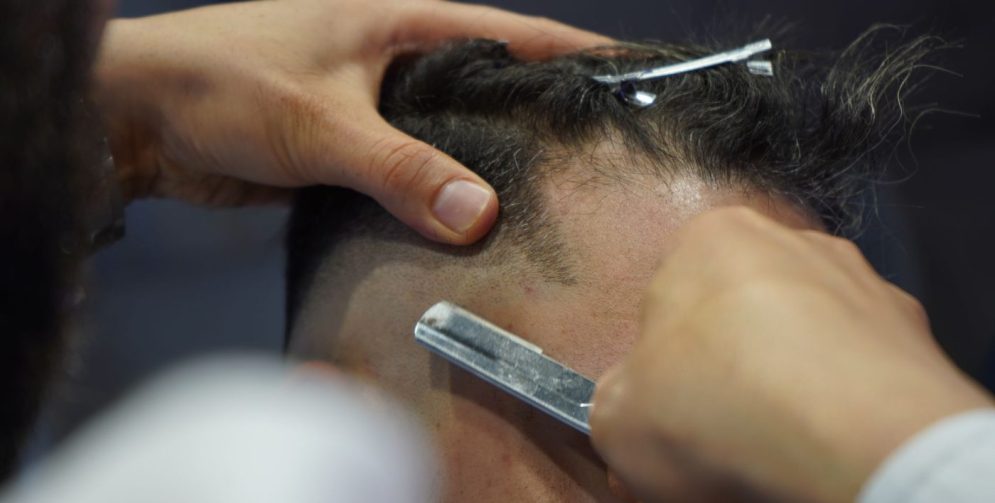
What are the best haircuts for men with thin hair?
The right cut creates the illusion of density. A good barber will leave enough weight where your hair is strongest and remove bulk only where it helps the shape. The five styles below work because they redirect attention to texture and structure rather than coverage.
- Textured crop. Short, choppy layers on top break up flat patches and catch light unevenly. This makes the scalp less visible. It suits straight or slightly wavy hair and requires minimal styling.
- Buzz cut with a fade. A uniform short length, usually a number 2 or 3 guard, removes the contrast between thin and thick areas. The skin fade on the sides sharpens the silhouette and draws the eye downward.
- Messy French crop. A short fringe swept forward hides a receding hairline. The textured top gives movement, while the blunt fringe line frames the face. It works best on fine, straight hair.
- Classic side part with low taper. The side part stacks hair to one side, building natural volume. A low taper keeps the sides tidy without exposing the scalp. This cut suits men who prefer a polished, office-ready look.
- Slicked-back undercut. Brushing the hair back lifts the roots and creates a smooth, continuous surface. The disconnected sides remove bulk and make the top appear thicker by comparison. Use a matte product to avoid a greasy finish.
Each of these cuts relies on a simple principle: less weight in the wrong places, more texture in the right ones. Your barber will adjust the proportions based on your hairline, crown density and head shape.
What should I tell my barber if I have thin hair?
Walk in and say "I want a cut that builds as much volume as possible." That one sentence tells your barber the goal is thickness, not just a trim. Follow it with where you notice the thinning most: "It is mainly the crown" or "My hairline has receded at the temples." Naming the spot helps your barber decide where to leave weight and where to take it shorter.
Avoid asking for a style that works against you. "Keep the length all over" is the most common request that makes thinning obvious, because long, unlayered hair lies flat and exposes the scalp. Instead, ask for "texture on top with a low skin fade on the sides." The contrast between a clean fade and textured length on top tricks the eye into reading the remaining hair as fuller.
- Ask for a dry cut on top so your barber can see exactly how your hair falls and where the gaps are.
- Request point cutting with scissors rather than a straight chop. This softens the ends and stops hair from clumping together.
- Say you want the sides and back faded tight, not left heavy. Bulk on the sides pulls attention away from volume on top.
- Mention your usual parting side. Your barber can cut against the natural fall to lift the hair at the root.
- If you use thickening products, tell your barber. A cut that works with matte clay needs different graduation than one styled with a wet look pomade.
How does a textured crop help thin hair?
A textured crop works because the choppy, uneven surface scatters light instead of reflecting it as a flat plane. When hair lies in a single uniform layer, any thin spot catches the eye immediately. A barber cuts the top with point cutting or deep notching so the strands fall at slightly different lengths. That broken texture stops the scalp from showing through in one obvious patch.
The short fringe and strong perimeter also pull attention away from the crown, where thinning often starts. A matte clay or paste pushed through the front section lifts the hair at the root and holds that separation all day. The style suits a receding hairline as well: the forward weight of the fringe frames the face without exposing the temples.
Why do barbers recommend a fade with thin hair?
A fade removes bulk from the sides and back, which immediately shifts attention to the top. The short tapered sides create a clean silhouette that makes whatever length you keep on top appear thicker by contrast. A low or mid fade works better than a high fade for most men with thin hair because it preserves more coverage around the crown and the occipital bone, where thinning often shows first.
Barbers lean on this technique because the eye naturally follows the gradient. When the sides drop from a 0.5 guard up to a 2, the transition pulls focus upward. The top does not need to be long. Even half an inch of textured hair looks denser against skin or a near-zero taper. A skin fade can work if your donor area is still full, but ask your barber to keep the blend low so the fade does not climb into the thinning zone.
Pair a fade with a squared-off neckline and a slightly heavier corner above the ear. That small adjustment frames the jaw and stops the cut from looking too soft, which is a common risk when hair is fine. The fade does the heavy lifting on shape, so you do not need loads of product to force volume where the hair cannot hold it.
How do I style thin hair at home without damaging it?
Thin hair needs volume, not weight. The right morning routine lifts the roots and keeps the style light, so your hair looks fuller without feeling stiff or greasy. Every step should avoid pulling, overheating or clogging the follicles.
- Towel-dry gently by patting, not rubbing. Rubbing roughs up the cuticle and can snap fragile strands.
- Apply a lightweight mousse or sea salt spray to damp hair, focusing on the roots. A pea-sized amount is enough for short styles.
- Use a blow-dryer with a concentrator nozzle on medium heat. Direct the airflow from the roots upward against the natural growth direction.
- Work with a vented brush or your fingers to lift sections at the crown. Avoid round brushes with dense bristles, which can pull and tangle thin hair.
- Finish with a cool shot button to set the shape and close the cuticle. Skip heavy pomades and waxes, which collapse the style by midday.
A quick spray of dry shampoo at the roots between washes absorbs oil and brings back texture. If you notice your scalp getting shiny or irritated, switch to a sulphate-free shampoo and blow-dry on a lower heat setting.
What mistakes make thin hair look worse?
A few everyday habits flatten your hair and draw attention to thinning spots. You can fix most of them this week without buying anything new.
Products and routines that work for thick hair often backfire on fine or thinning hair. Heavy pomades, for example, clump strands together and expose the scalp underneath. Over-washing strips the natural oils that give hair its grip and texture, leaving it limp by midday. Letting the sides grow too long creates a heavy silhouette that makes the top look even sparser by comparison.
The most common mistakes barbers see, and how to avoid them:
- Using heavy oil-based pomades or greasy waxes that weigh hair down and separate it into strands. Switch to a light matte clay or a volumising powder that adds grip without shine.
- Washing your hair every day with harsh shampoos. Cut back to two or three times a week and use a gentle, sulphate-free shampoo to preserve natural texture.
- Letting the sides grow beyond two or three weeks. Short, tapered sides create contrast that makes the hair on top look fuller immediately.
- Combing hair flat against the scalp with a fine-tooth comb. Use your fingers or a wide-tooth comb to lift the roots and direct hair upward.
- Applying conditioner or styling product directly to the roots. Keep conditioner on the ends only and work product through the mid-lengths first, then lightly onto the surface.
- Ignoring a haircut for more than four weeks. Thin hair loses its shape quickly as it grows, so a regular trim every three to four weeks keeps the style looking intentional and full.
FAQ
Does a buzz cut work for men with thin hair?
Yes. A short, even buzz cut reduces the contrast between thick and thin areas, making the overall look more uniform. It works best when the thinning is fairly consistent across the scalp rather than in isolated patches.
Should I use conditioner if my hair is thin?
Yes, but use a lightweight, volumising conditioner only on the ends. It prevents dryness without weighing the hair down. Avoid heavy, creamy conditioners and keep the product away from the roots.
How often should I get a haircut to keep thin hair looking good?
Every three to four weeks. As thin hair grows, it tends to lose shape and look wispy, so a regular trim keeps the style defined and the proportions balanced.
